


[Event Report] The 139th HGPI Seminar “New Perspectives in Cardiovascular Disease Control – From the Viewpoint of Patient and Public Involvement” (October 9, 2025)
date : 2/3/2026
Tags: Cardiovascular Diseases, HGPI Seminar, NCDs

![[Event Report] The 139th HGPI Seminar “New Perspectives in Cardiovascular Disease Control – From the Viewpoint of Patient and Public Involvement” (October 9, 2025)](https://hgpi.org/en/wp-content/uploads/sites/2/HGPI_20251009_139thHGPIseminar_eyechatch-e1769474134916.jpg)
The 139th HGPI Seminar welcomed Dr. Sachiko Kanki, Assistant Professor, Department of Thoracic and Cardiovascular Surgery, Division of Surgery, Faculty of Medicine, Osaka Medical and Pharmaceutical University, and Physician, Department of Cardiovascular Surgery, Osaka Medical and Pharmaceutical University Hospital.
Dr. Kanki has long been engaged in promoting collaboration with patient organizations through her work with the Japanese Circulation Association and has played a leading role in advancing patient and public involvement (PPI) in the field of cardiovascular care. In addition to her clinical practice, she serves as Deputy Director of the Center for Support of Female Physicians and Researchers at her university, is an Associate Member of the Science Council of Japan, and holds various committee and council positions in academic societies. Through these roles, she has contributed broadly across clinical practice, research, and medical education.
In this seminar, Dr. Kanki delivered a lecture on the current state and future direction of cardiovascular disease policies in Japan, highlighting the importance of incorporating patient and public perspectives. Her presentation was illustrated with numerous real-world examples drawn from her extensive professional experience.
<POINTS>
- Cardiovascular diseases remain one of the leading causes of death in Japan, continuing to rank second only to malignant neoplasms. Meanwhile, mortality rates from cerebrovascular disease have declined significantly alongside increased public awareness.
- Due to rapid population aging, cardiovascular diseases—particularly heart failure—are rapidly increasing. A A “heart failure pandemic” is predicted to occur in 2055, with the number of patients expected to exceed one million. This presents an urgent issue in this field.
- Among cardiovascular conditions, rare hereditary aortic diseases—such as Marfan syndrome, Loeys–Dietz syndrome, and vascular Ehlers–Danlos syndrome—require early diagnosis and continuous management at the family level to prevent severe complications.
- Following the enactment in 2019 of the Basic Act on Countermeasures for Stroke, Heart Disease, and Other Cardiovascular Diseases to Extend Healthy Life Expectancy (hereinafter referred to as the “Basic Act on Cardiovascular Disease Control”) to provide comprehensive support for cardiovascular disease, from prevention to treatment. This was followed by the establishment of the Japanese Circulation Association in 2021. Together, this has raised expectations for more effective cardiovascular disease control through collaboration among patient organizations, healthcare professionals, and government agencies, to promote effective cardiovascular disease measures that reflect the perspectives of those affected through patient and public involvement (PPI).
Public Awareness and Mortality Trends in Stroke and Cardiovascular Disease
In Japan’s cause-of-death statistics, heart disease (excluding hypertension) has consistently ranked second after malignant neoplasms, with mortality rates remaining largely stable over the past two decades. In contrast, trends in cerebrovascular disease present an important and instructive case. As accurate knowledge and public understanding of cerebrovascular disease have spread, mortality rates have declined significantly. Specifically, in 2003, cerebrovascular disease accounted for 13% of all causes of death (ranking third), but by 2023 it had fallen to 6.6% (ranking fourth). These trends suggest that improved understanding of disease contributes to prevention, earlier medical consultation, and ultimately to lower mortality.
However, challenges remain regarding overall public awareness of cardiovascular diseases. According to a national survey conducted by the Japan Stroke Association and the Japanese Circulation Society as part of the Ministry of Health, Labour and Welfare’s FY2024 public awareness initiative, 43.4% of respondents reported that they were “knowledgeable” or “somewhat knowledgeable” about stroke and heart disease. On the other hand, awareness of specific conditions—such as heart failure, angina pectoris, aortic aneurysm rupture, atrial fibrillation, and acute aortic dissection—was generally low, highlighting gaps in which the public does not fully understand the specific risks and symptoms of these diseases.
Lifestyle Risk Management in Anticipation of the Growing Burden of Heart Failure
While the mortality rate from cerebrovascular disease has declined, the increasing prevalence of cardiovascular diseases—particularly heart failure—represents one of the most pressing challenges for Japan as a super-aging society. The number of newly diagnosed heart failure patients aged 65 and older is expected to rise sharply through 2030, with patient numbers expected to exceed one million by 2055, ushering in a “heart failure pandemic.”
The impact of cardiovascular disease extends beyond survival alone. Among the major causes requiring long-term care, cardiovascular diseases accounts for 21.2%, second only to geriatric syndromes such as dementia and fractures (53.9%). Heart failure is considered to have four key opportunities for prevention across the life course, underscoring the importance of managing lifestyle-related risk factors, including hypertension, dyslipidemia, diabetes, smoking, alcohol consumption, physical inactivity, and infectious diseases.
The Importance of Early Diagnosis in the Treatment of Rare Diseases
Among cardiovascular conditions, rare and intractable cardiovascular diseases, including rare hereditary aortic diseases, require particular early diagnosis and continuous management, including for family members. In clinical practice, severe cases have been reported in which patients with connective tissue disorders—such as vascular Ehlers–Danlos syndrome (vEDS) and Marfan syndrome—experience vascular injury following even minor physical movements.
Marfan syndrome is characterized by fragility of connective tissue throughout the body and may involve life-threatening complications such as tall stature, skeletal abnormalities, lens dislocation, and aortic aneurysms and dissections. As an autosomal dominant condition, it carries an approximately 50% risk of inheritance. However, appropriate screening, regular imaging diagnostics, and genetic counseling can help prevent severe complications. In fact, in some cases the diagnosis of a single patient has led to identification and timely management of the same condition among family members, leading to appropriate treatment.
Aortic diseases can progress extremely rapidly. In acute aortic dissection, mortality is reported to increase by approximately 1% per hour after onset. In such time-critical situations, the development of medical networks capable of providing rapid diagnosis and treatment—such as the “Acute Aortic Super Network”—is essential. At present, however, regional disparities remain, with limited coverage outside the Tokyo metropolitan area.
The Role of Patient Organizations from the Perspective of Patients and Families
Patients with rare and intractable diseases and their families face diverse challenges. In addition to limited access to physicians knowledgeable about their disease, they face the anxiety of overlooking serious illnesses, feel isolated due to lack of understanding from those around them, and lack of information and guidance on how to appropriately plan their lifestyles for their disease at each stage of life, such as attending school, finding employment, and working. These challenges present significant challenges not only in terms of medical care but also in everyday life. Furthermore, the lack of support and consultations for applying for intractable disease and disability pensions places a significant burden on patients.
In this context, patient organizations play an important role as platforms for connection and information sharing. Through patient gatherings and initiatives involving healthcare professionals as medical advisors, these organizations have directly listened to the voices of patients and their families and promoted the system helping connect medical care with daily life support. In recent years, international awareness initiatives originating in Europe and the United States—such as Aortic Dissection Awareness Day and the slogan “Think Aorta”—have also been introduced in Japan. Since a lecture held in Osaka in 2018, organizations including the Japan Marfan Association have continued efforts to raise awareness of aortic diseases among healthcare professionals and the general public.
Challenges Facing Patient Organizations and Initiatives by the Japanese Circulation Association
While patient organizations play essential roles in raising awareness, information sharing, and policy advocacy, they face serious and structural challenges in their operation. There is a notable shortage of personnel and successors to support activities, with workloads excessively concentrated on specific members. Additionally, while patients increasingly obtain information individually through social media and other channels, there is a decline in participation by younger generations, making it difficult to maintain the foundation of the association. Furthermore, the unstable financial foundation, such as unstable membership fee income and the immaturity of the donation culture in Japan, may lead to a decline in its influence in policy advocacy and social outreach.
In response to these challenges, the Japanese Circulation Association, established in 2021, serves as a collaborative platform connecting diverse stakeholders, including healthcare professionals, patients, companies, and government. Through its Patient Collaboration Committee, the association promotes networking among patient organizations and works to reflect patient and public perspectives in policy proposals and awareness activities. Furthermore, opportunities for direct dialogue between experts and those affected are expanding through measures such as setting up patient association booths at the Japanese Circulation Society’s academic conferences. Public awareness initiatives include “Heart Health Day” on August 10, the “Go Red for Women” campaign focusing on cardiovascular disease in women, and educational events helping children learn about heart health. Through these multilayered efforts, the association aims to foster a social environment in which patient organizations can play sustainable roles.
The Importance of Patient and Public Involvement and Future Perspectives
Healthcare is not created by professionals alone; it is something that is built collaboratively with active participation from citizens. Active citizen involvement in the medical decision-making process is essential to ensure decisions that respect each individual’s values, background, and genetic characteristics. Patient organizations play multifaceted roles—including information provision, peer support, policy advocacy, public awareness, and research collaboration—helping to strengthen mutual understanding between patients and healthcare professionals, and building relationships in which everyone can receive medical care with peace of mind.
Looking ahead, future cardiovascular disease prevention efforts require sustainable mechanisms to support patient organization activities. Governments are required to provide institutional and financial support, while medical and educational institutions are required to promote interprofessional collaboration and incorporate the experiences of patients and other affected individuals into education. Companies and research organizations are also expected to promote patient and public involvement (PPI) by integrating patient and citizen perspectives into policy, education, and research processes. Through such multi-layered collaboration, trust between healthcare and society can be strengthened, contributing to an environment in which everyone can access medical care with peace of mind, leading to the sustainable development of health policy as a whole.
[Event Overview]
- Speaker:
Dr. Sachiko Kanki (Assistant Professor, Department of Thoracic and Cardiovascular Surgery, Division of Surgery, Faculty of Medicine, Osaka Medical and Pharmaceutical University; Physician, Department of Cardiovascular Surgery, Osaka Medical and Pharmaceutical University Hospital)
- Date & Time: Thursday, October 9, 2025; 18:00-19:15 JST
- Format: Online (Zoom webinar)
- Language: Japanese
- Participation Fee: Free
- Capacity: 500 participants
■Profile:
Sachiko Kanki (Assistant Professor, Department of Thoracic and Cardiovascular Surgery, Division of Surgery, Faculty of Medicine, Osaka Medical and Pharmaceutical University; Physician, Department of Cardiovascular Surgery, Osaka Medical and Pharmaceutical University Hospital)
Professor Sachiko Kanki graduated from the Faculty of Medicine at Osaka Medical College (currently the Osaka Medical and Pharmaceutical University) in 1999. Specializing in cardiovascular surgery, she completed postgraduate studies after a residency at Osaka Medical College Hospital and the Center for Emergency and Critical Care Medicine. She was appointed Assistant Professor in 2005 and served as Research Fellow at Brigham and Women’s Hospital, a Harvard University-affiliated teaching hospital, for three years starting in 2007. She then returned to Japan where she became Assistant Professor in the Department of Thoracic and Cardiovascular Surgery before assuming her current position in 2020. At Osaka Medical and Pharmaceutical University, her other roles include Deputy Director at the Center for Smart Woman Doctors and Researchers and Faculty Member of the Education Center. She also serves as an Affiliate Member of the Science Council of Japan and as a committee member or councilor for a number of academic societies. She also leads the Patient Collaboration Committee at the Japanese Circulation Association, where she advances joint efforts with patient associations. She is a board-certified surgeon of the Japan Surgical Society, a board-certified cardiologist of the Japanese Circulation Society, a board-certified Kampo medicine specialist, and a board-certified clinical geneticist.

Related Posts
-
2025-12-12
[Registration Closed] (Webinar) The 140th HGPI Seminar “Early Detection to Reduce COPD Disease Burden: Connecting Clinical Frontiers with Health Policy” (January 27, 2026)
-
2026-01-05
[Event Report] The 138th HGPI Seminar “Stress Management Education that Protects Children’s Futures – The Importance of Preventive Mental Health Support” (August 28, 2025)
-
2025-07-04
[Event Report] The HGPI Cardiovascular Disease (CVD) Control Promotion Project Online Global Symposium "Exploring the Future of CVD Control Through Policy Case Studies in the Asia-Pacific Region" (March 13, 2025)
-
2025-05-27
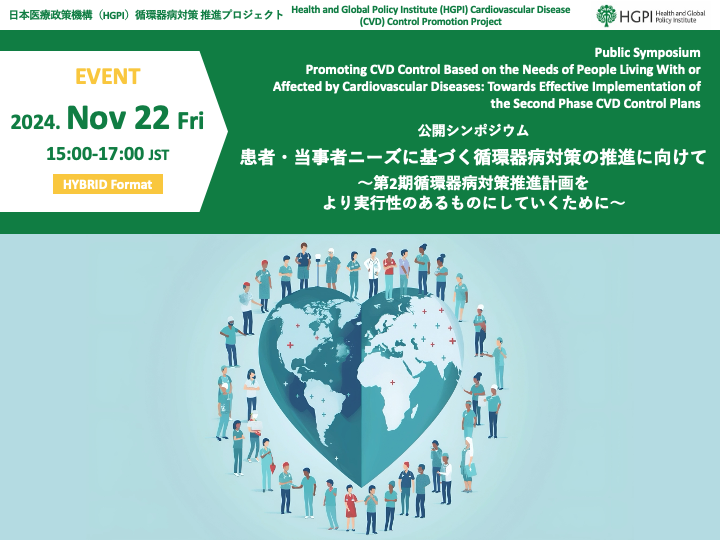
[Event Report] Public Symposium "Promoting CVD Control Based on the Needs of People Living with or Affected by Cardiovascular Diseases: Towards Effective Implementation of the Second Phase CVD Control Plans" (November 22, 2024)
-
2024-05-30
[Recommendations] Developing and Expanding Cardiovascular Disease Control Plans in Each Prefecture – Challenges and Good Examples for Cardiovascular Disease Control Addendum (May 30, 2024)
Top Research & Recommendations Posts
- [Research Report] The 2025 Public Opinion Survey on Healthcare in Japan (March 17, 2025)
- [Policy Recommendations] The Path to a Sustainable Healthcare System: Three Key Objectives for Public Deliberation (January 22, 2026)
- [Research Report] Perceptions, Knowledge, Actions and Perspectives of Healthcare Organizations in Japan in Relation to Climate Change and Health: A Cross-Sectional Study (November 13, 2025)
- [Policy Recommendations] Reshaping Japan’s Immunization Policy for Life Course Coverage and Vaccine Equity: Challenges and Prospects for an Era of Prevention and Health Promotion (April 25, 2025)
- [Policy Recommendations] Developing a National Health and Climate Strategy for Japan (June 26, 2024)
- [Policy Recommendations] Mental Health Project: Recommendations on Three Issues in the Area of Mental Health (July 4, 2025)
- [Research Report] The 2023 Public Opinion Survey on Satisfaction in Healthcare in Japan and Healthcare Applications of Generative AI (January 11, 2024)
- [Research Report] Survey of Japanese Physicians Regarding Climate Change and Health (December 3, 2023)
- [Recommendations] “Balancing Sustainability and Innovation in the Healthcare System” (December 26, 2025)
- [Publication Report] Planetary Health Promotion Project “Issues Facing Planetary Health and the Role of the Health Sector” (May 10, 2023)
Featured Posts
-
2026-01-09
[Registration Open] (Hybrid Format) Dementia Project FY2025 Initiative Concluding Symposium “The Future of Dementia Policy Surrounding Families and Others Who Care for People with Dementia” (March 9, 2026)
![[Registration Open] (Hybrid Format) Dementia Project FY2025 Initiative Concluding Symposium “The Future of Dementia Policy Surrounding Families and Others Who Care for People with Dementia” (March 9, 2026)](https://hgpi.org/en/wp-content/uploads/sites/2/dementia-20260309-top.png)
-
2026-01-22
[Policy Recommendations] The Path to a Sustainable Healthcare System: Three Key Objectives for Public Deliberation (January 22, 2026)
![[Policy Recommendations] The Path to a Sustainable Healthcare System: Three Key Objectives for Public Deliberation (January 22, 2026)](https://hgpi.org/en/wp-content/uploads/sites/2/is-20260122-top_ENG.png)
-
2026-01-26
[HGPI Policy Column] (No.68) – From the Intractable and Rare Diseases Project “Part 2 – Making Intractable and Rare Diseases a Priority Issue for the International Community: The WHA Resolution’s Vision for a Global Action Plan and Japan’s Role”
![[HGPI Policy Column] (No.68) – From the Intractable and Rare Diseases Project “Part 2 – Making Intractable and Rare Diseases a Priority Issue for the International Community: The WHA Resolution’s Vision for a Global Action Plan and Japan’s Role”](https://hgpi.org/en/wp-content/uploads/sites/2/Eyecatch_Column_RD_2-1.png)
-
2026-01-26
[Policy Recommendations] Reshaping Japan’s Immunization Policy for Life Course Coverage and Vaccine Equity: Challenges and Prospects for an Era of Prevention and Health Promotion (April 25, 2025)
![[Policy Recommendations] Reshaping Japan’s Immunization Policy for Life Course Coverage and Vaccine Equity: Challenges and Prospects for an Era of Prevention and Health Promotion (April 25, 2025)](https://hgpi.org/en/wp-content/uploads/sites/2/vc-20250425-top.jpg)
